In May 2010, Ethan Marcotte introduced responsive web design to the world. He correctly explained that website design and development should respond to the user's behaviour and environment based on screen size, platform and orientation. Although this solved the browser and platform compatibility challenge, most web designers invested tremendous resources into the index page of a website, and not enough focus was put on anything else on a site map. Consequently, if a prospect lands on any page other than the index, the probability of conversion is much lower.
So we took every layer of the main page, decoupled them from the index, and opened up the capability for any page on the website to display any strip by checking a box. Now, regardless of where a prospect lands, the quality of the content and probability of conversion is the same. Think of your website as a tool that pitches your site visitors, virtually on your product or service, 24/7. Each layer or snippet is inspired by the sales process. Pretend you’re presenting your business to a potential customer. You’ll start by giving them an overview of their business, then you’ll go into benefits/differentiators, the services you’ve offered wins you’ve had and of course, your process. Scroll below to learn about each layer and think about it from the lens of a comprehensive virtual pitch.
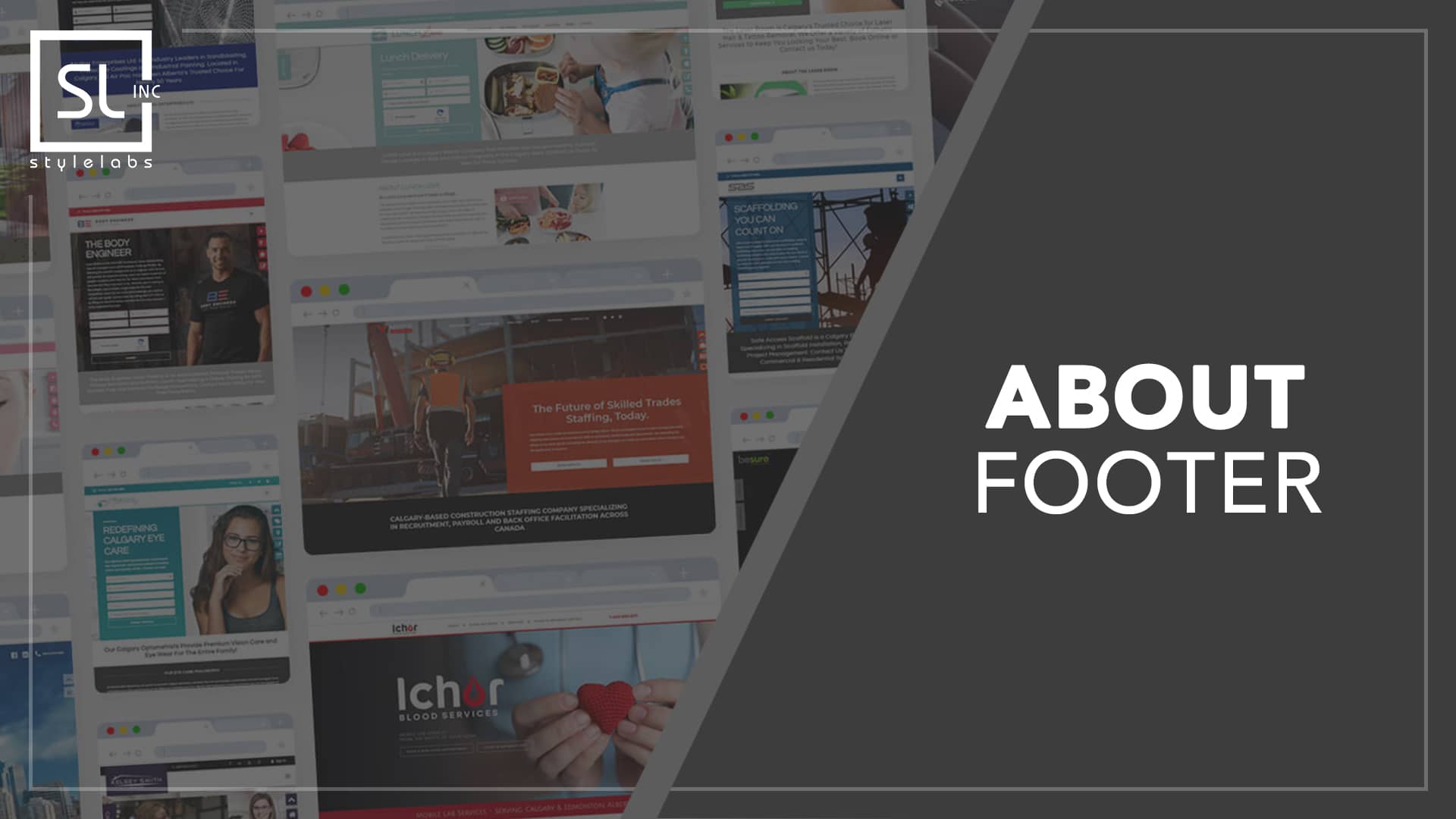
An About Footer is where you let your brand identity shine! It's the last resource we can use to convince your potential client to do business with your company. This is often content that communicates what your company stands for, your mission, vision or values, an elevator pitch or a company differentiator that drives the end-user to contact you. It is strategically placed directly above the contact form to provide an invested reader with a condensed summary of your organization’s scope.
Every purchaser has options. Why should they work with you? What makes you different? Through icons, headers and short text this snippet emphasizes to the prospect what makes you different and more valuable to an organization. Whether it be cost, experience, process, track record or experience, the benefits section will present a clear value proposition in under 15 seconds.
Brand Strips are a showcase of linked logos that are presented in a carousel format in coloured or monochromatic iterations. This is a very fluid snippet. It can be used to showcase clients you work with, associates you’re a part of, awards you’ve won, partners or technologies you leverage and so much more.
The purpose of the brand strip is to demonstrate credibility of your organization by showcasing who you associate with. It shows that you’ve been around, you’re reputable and have a track record.
Interruptors are layers in a website designed to pause the flow of the sales process with the involved prospect and speed up conversion. This is done by offering concessions like an e-book, free consultation or a redirection to a specific part of the site (like a booking page).
The goal is to capture the prospect’s information faster and merge them into a lead funnel for further engagement. Click below to see examples of our interruptors.
When a prospect lands on your site, it is important to capture as much information from them as possible in order to maximize the probability of conversion.
The embedded form snippet allows you to drop embed code into any page on your site in a neat and functional container. Typically this is used for intake forms (like ParQ’s for personal trainers), job applications, surveys or even DocuSign contracts.
Our studies show that Google optimizes questions better than statements. This is why we developed a module, delivered in an accordion format that asks and answers questions most commonly asked in Google search about a product or service. We conducted an A|B test in 2020 and confirmed that pages with Frequently Asked Questions improved conversions by 5-10% depending on the industry.
FAQ’s are a very effective tool for both first-time site visitors and for the internal sales team for education or as a supplement to the sales process. These can be used as references or addendums to proposals and agreements to deliver with transparency and completeness.
Like featured pages, featured blogs pulls different articles on different pages depending on your goals and objectives. For example, if you’re a chiropractor specializing in Motor Vehicle Accidents and Shockwave, your main page will feature your most recent blogs while your Shockwave page will feature shockwave blogs.
From an SEO standpoint, this adds authority to your page by demonstrating opinion leadership to a service page with content. Additionally, it creates a rabbit hole for prospects to go through improving time on site and pages per session.
A website typically has dedicated pages for each product and service it offers. The featured pages service showcases whichever products or services you want to present to a site visitor on a particular page.
This typically presents as a vertical stack or a horizontal carousel/ticker. You can customize this snippet for each page. On the index, it typically presents as a collection of your company’s top earners. On service/product pages or blog pages, it is typically a strip of “related” or “complimentary” products or services. Our studies show that this is an excellent tool for upwelling.
Interruptors are layers in a website designed to pause the flow of the sales process with the involved prospect and speed up conversion. This is done by offering concessions like an e-book, free consultation or a redirection to a specific part of the site (like a booking page).
The goal is to capture the prospect’s information faster and merge them into a lead funnel for further engagement. Click below to see examples of our interruptors.
For businesses that have multiple locations, the location snippet has proven to significantly help optimization as well as boost conversion. Each snippet displays postcards with call-to-action buttons that are presented in a carousel on any site of the website. The cards can link to micro pages, booking pages, activate mobile maps or all of the above.
Your website process snippet outlines the key stages of your business' journey when onboarding a new client or outlines the journey every client will go through every time they sign with you. Roadmaps allow clients to understand the steps they will follow and will give them peace of mind.
Online customer reviews give you a steady pipeline of positive content that search engines value highly when choosing which results to return. When you're ranked higher, algorithms and people alike tend to see your website as an authority in your industry, which also leads to more exposure.
The review snippet pulls all positive reviews from Google and Facebook providing users with social proof that you deliver on your brand promise.
Our data has confirmed that in many industries, brand humanization significantly impacts conversion. People do business with people they like. They also like to put faces to a brand. By showcasing key members of your team, you’re showing your prospect that there is a credible team behind your offering and that team is made up of regular, relatable human beings, just like them.

Loren ipsum dolor sit amet, quod omnesque sea te. Qui latine fabellas ad, fastidii scaevola instructior ad est. Malorum democritum duo ea, usu sale viris insolens no, cu probo semper tamquam sea. Ex assum officiis omittantur vel, docendi corpora sed in. Erant clita dictas sea ex, prima quodsi postulant ad usu. Mucius incorrupte duo an, qui exerci recteque reformidans in.